
What is the Moisture Structure in Seeds Like?
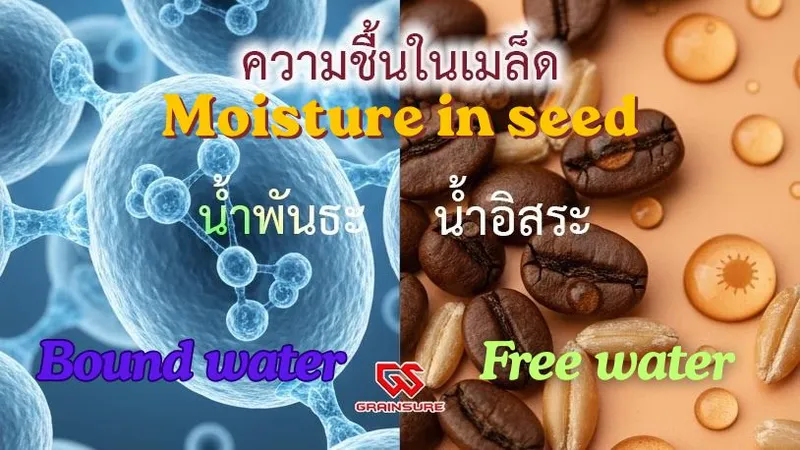
Moisture in Seeds
Where is it located in the seed, and how does it affect seed quality?
Get to know the invisible mechanism that has a massive impact on quality and shelf life.
[cite_start]When talking about “Moisture Content” in materials science or agriculture, many people might only think of the wetness or dryness that can be physically felt. [cite: 25, 26] [cite_start]However, in reality, moisture content is a complex mechanism that dictates the quality, shelf life, and stability of that material, especially in all types of plant seeds. [cite: 26]
Definition of Moisture Content in Materials
[cite_start]Moisture content is the amount of water that infiltrates or constitutes the tissue of a material. [cite: 26] [cite_start]It is mostly reported as a “percentage of water weight relative to the total weight.” [cite: 26] [cite_start]This water does not just stay idle but functions in completely different ways. [cite: 26] [cite_start]We can classify the states of water into 2 main categories: [cite: 26]
Bound Water
Water as a structural component
This is the water that is “essential to the life and shape” of the material. [cite: 27] This group of water molecularly binds tightly to the primary structure, such as proteins, starch, or cell walls. [cite: 27]
- Role: Helps maintain cell flexibility and stability. [cite: 27]
- Key Feature: Highly difficult to evaporate even under intense sunlight, and microorganisms cannot utilize this part of water for growth. [cite: 27]
- Importance: If we force this water out, it will cause the material to become brittle and crack, or if it is a seed, that seed will “die” instantly. [cite: 27]
Free Water
Excess water that is mobile
This is the water located in the intercellular spaces or within the pores of the material, comparable to water trapped in wood grooves or on contact surfaces. [cite: 28]
- Role: Acts as a solvent and a carrier in various chemical reactions. [cite: 28]
- Key Feature: Easily evaporates through heat and ventilation. [cite: 28]
- Importance: This part of water is the “culprit.” If there is too much of it, it will stimulate mold, bacteria, and lead to accelerated spoilage. [cite: 28]
Why Do We Need to Control Moisture Content?
[cite_start]Whether it is seeds, paddy, wood, or even other biomaterials, moisture management has 3 primary objectives: [cite: 29]
- [cite_start]Longevity: Reducing free water levels helps “freeze” the degradation process, allowing materials to be stored for longer periods. [cite: 29]
- Pest Control: Molds and insects require free water to survive. [cite_start]Dryness of the material is therefore the most effective natural method. [cite: 29]
- Commercial Viability: Moisture content directly affects “weight” and “quality.” [cite_start]Global trade therefore requires clear standard values. [cite: 29]
Effective Methods to Reduce Free Water
To extract as much free water as possible without damaging the seeds, the following techniques should be used:
Drying at a temperature of 40-43°C is the safest point. It allows free water to gradually evaporate from the deep layers of the seed without causing the seed coat to harden and block the water’s pathway (Case Hardening).
The evaporated free water becomes humidity in the air surrounding the seeds. Without good ventilation, water will re-enter the seeds. Fans should be used to continuously blow out the humid air.
For storage in closed containers, using silica gel or high-quality desiccant beads will help pull out the minor remaining free water much better than using heat alone.
Instead of measuring only weight, use a water activity meter to confirm that free water has dropped below 0.6, which is the level where mold absolutely cannot grow.
Summary: Proper drying is not about drying down to 0%, but it is about removing free water down to a safe level.
✨ Summary
Moisture content in seeds and materials is not just about wetness, but it is about maintaining a proper balance between having enough water to preserve the structure (Bound Water) and eliminating excess water that brings damage (Free Water). Understanding this difference helps us manage agricultural materials and yields with maximum efficiency.
Looking for an Accurate Moisture Meter?
Control Your Crop Quality with Precision Moisture Standards
Ensure certainty across your crop quality control processes with Grainsure moisture meters, specifically developed for corn and maize applications.